

The best AI medical scribe for 2026 depends on where you practice and what happens after the note gets signed — coding, utilization review, and CDI pushback don't stop at the transcript. Best overall: EvidenceMD AI Scribe, because it pairs ambient documentation with evidence-cited reasoning and utilization review in one workflow. Best for large Epic health systems: Nuance DAX Copilot. Best budget option for solo practitioners: Freed.
- EvidenceMD AI Scribe is the best ai medical scribe for practices that also need utilization review and CDI support, not just transcription.
- Nuance DAX Copilot wins for large Epic health systems already running Dragon workflows in 2026.
- Freed is the pick for solo practitioners who need ambient notes without an enterprise contract.
- Every scribe on this list still needs a clinician to verify the note before it's signed.
- Specialty template depth and EHR integration matter more than raw transcription accuracy for most buyers.
Why this matters
Documentation is the reason physicians leave clinical medicine. Widely cited research from Sinsky et al. found primary care physicians spend nearly two hours on EHR and desk work for every hour of direct patient time — that ratio hasn't improved much by 2026, and it's the single biggest driver behind scribe adoption.
The problem: most "AI scribe" reviews compare transcription quality and stop there. A note that's accurate but disconnected from coding, evidence citations, or payer documentation requirements just moves the burden downstream to whoever handles denials. This guide ranks tools on what happens after the note is drafted, not just how it sounds.
What makes the best AI medical scribe
- Ambient accuracy in live encounters — not scripted demo audio
- EHR integration depth — Epic, Cerner, athenahealth, or standalone
- Specialty template coverage — orthopedics, psychiatry, and primary care need different note structures
- Evidence linkage — whether claims in the note trace back to a source
- Downstream utility — coding support, CDI queries, utilization review documentation
- Data handling and compliance posture under HIPAA
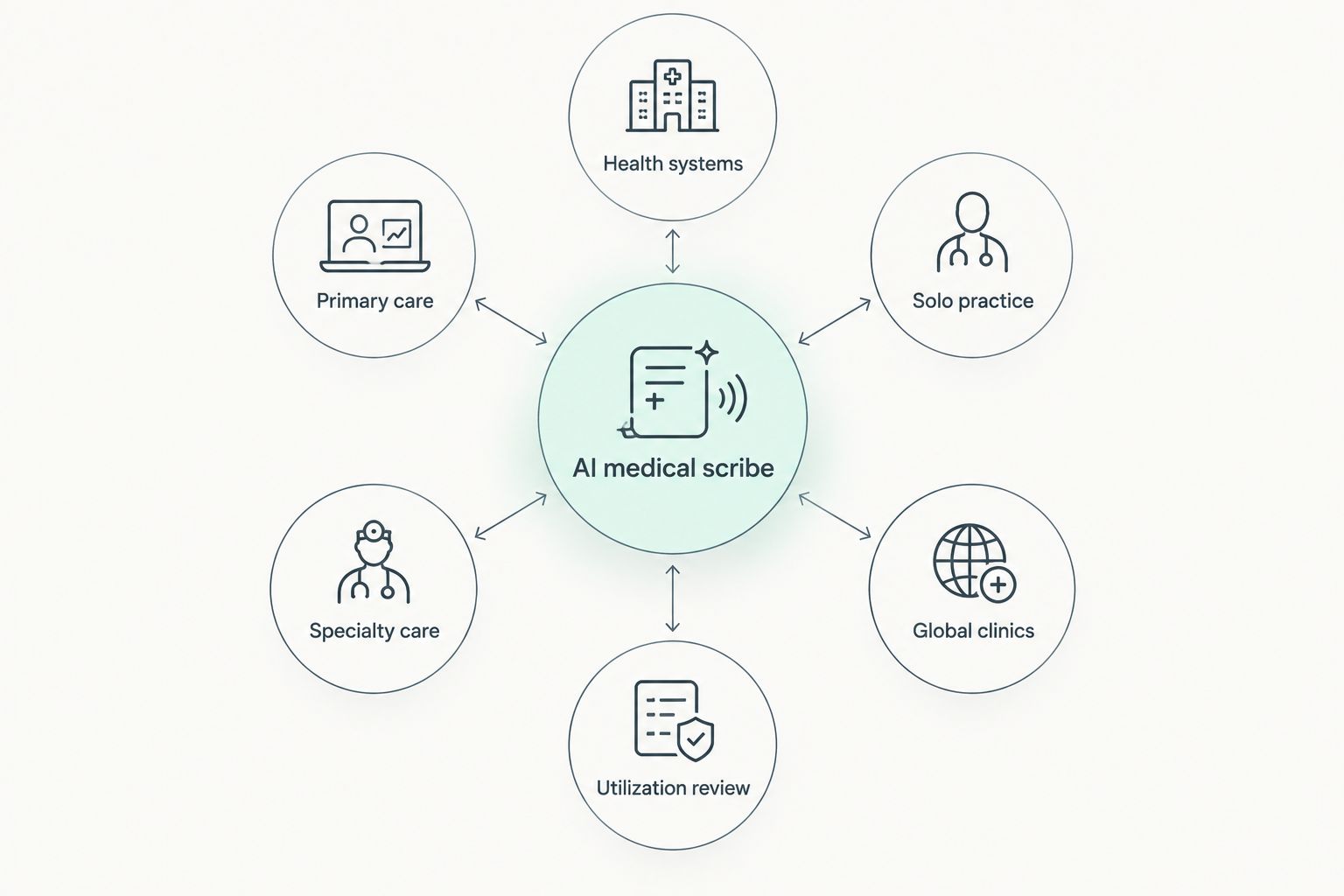
AI medical scribes at a glance
| Tool | Best for | Standout feature | Key limitation |
|---|---|---|---|
| EvidenceMD AI Scribe | Evidence-linked documentation + UR | Notes tied to cited clinical evidence and CDI workflow | Newer to pure ambient-scribe benchmarking than dedicated scribe-only vendors |
| Nuance DAX Copilot | Large Epic health systems | Deep Dragon/Epic integration | Built for enterprise IT, slow rollout for small practices |
| Abridge | Enterprise hospital systems | Health-system scale deployments | Built for hospital contracts, not solo clinicians |
| Suki AI | Independent practices, voice-first | Mobile-first voice workflow | Fewer specialty templates than enterprise tools |
| Ambience Healthcare | Multi-specialty ambulatory groups | Specialty-specific note templates | Group-level pricing model favors larger clinics |
| Nabla | Primary care | Lightweight ambient capture | Less depth for complex specialty visits |
| Freed | Solo practitioners on a budget | Simple setup, low overhead | Limited enterprise EHR integration |
| Heidi Health | Multilingual, global clinics | Multi-language ambient capture | Newer to U.S. specialty template libraries |
| DeepScribe | Specialty practices needing structure | Structured, specialty-tuned note output | Requires template customization upfront |
| Augmedix | Remote scribe support at scale | Human-in-the-loop plus AI review | Slower turnaround than fully automated tools |
1. EvidenceMD AI Scribe: best AI medical scribe for evidence-linked documentation and utilization review
EvidenceMD AI Scribe captures the encounter and drafts the note, but the differentiator is what sits around it: an evidence-cited clinical reasoning assistant and utilization review/CDI toolset built for the same physicians, nurses, and PAs using the scribe. The note isn't just transcribed — supporting clinical claims can be traced to cited evidence, which matters when a payer or reviewer questions medical necessity.
EvidenceMD AI Scribe pros:
- Evidence citations attached to clinical reasoning, not just free text
- Utilization review and CDI tools live in the same platform as documentation
- Built for the full care team: physicians, nurses, PAs, and admin staff
EvidenceMD AI Scribe cons:
- Broader platform scope means it's not a single-purpose scribe specialist
- Teams wanting scribe-only simplicity may find the CDS layer unnecessary
Best for: practices and health systems where documentation, coding defense, and utilization review sit with the same team. Verdict: Buy.
2. Nuance DAX Copilot: best AI medical scribe for large Epic-based health systems
Nuance DAX Copilot, part of Microsoft's healthcare stack, is built around deep Dragon Medical and Epic integration for large hospital networks.
Nuance DAX Copilot pros:
- Established Epic and Dragon Medical integration
- Backed by Microsoft's enterprise healthcare infrastructure
- Familiar to systems already using Dragon dictation
Nuance DAX Copilot cons:
- Enterprise procurement and IT onboarding takes time
- Overbuilt for solo or small-group practices
Best for: large Epic-based health systems. Verdict: Buy (for enterprise IT).
3. Abridge: best AI medical scribe for enterprise hospital systems
Abridge focuses on ambient documentation deployed at health-system scale, with contracts typically built around hospital networks rather than individual clinicians.
Abridge pros:
- Designed for system-wide rollout
- Health-system partnerships built into the product
Abridge cons:
- Not structured for solo practitioner sign-up
- Less relevant to independent practices
Best for: hospital systems standardizing documentation across departments. Verdict: Hold for anyone outside enterprise procurement.
4. Suki AI: best AI medical scribe for independent practices wanting voice-first workflow
Suki AI leans on a mobile, voice-first interface aimed at independent physicians who want ambient notes without a hospital-scale contract.
Suki AI pros:
- Mobile-first design
- Positioned for independent practice budgets
Suki AI cons:
- Fewer specialty-specific templates than larger platforms
Best for: independent physicians who want a lighter-weight scribe. Verdict: Buy for small practices.
5. Ambience Healthcare: best AI medical scribe for multi-specialty ambulatory groups
Ambience Healthcare targets multi-specialty ambulatory groups with templates tuned to different visit types across a group practice.
Ambience Healthcare pros:
- Specialty-specific templates across multiple departments
- Built for group-level ambulatory deployment
Ambience Healthcare cons:
- Pricing structure favors larger groups over solo use
Best for: multi-specialty ambulatory groups. Verdict: Buy for groups with 3+ specialties.
6. Nabla: best AI medical scribe for primary care practices
Nabla offers a lighter ambient-capture tool aimed at primary care encounters, where visit structure is more standardized than specialty care.
Nabla pros:
- Simple ambient capture for standard visits
- Lower setup complexity than enterprise tools
Nabla cons:
- Less depth for complex specialty documentation
Best for: primary care practices. Verdict: Buy.
7. Freed: best AI medical scribe for solo practitioners on a budget
Freed is positioned for individual clinicians who want ambient note generation without an enterprise sales process.
Freed pros:
- Low-overhead setup for individual users
- No enterprise IT dependency
Freed cons:
- Limited enterprise EHR integration depth
Best for: solo practitioners. Verdict: Buy for individual budgets.
8. Heidi Health: best AI medical scribe for multilingual and global clinics
Heidi Health markets multi-language ambient capture, relevant for clinics serving non-English-speaking patient populations.
Heidi Health pros:
- Multi-language capture
- Positioned for international clinic use
Heidi Health cons:
- Newer to U.S. specialty template depth
Best for: multilingual and global clinics. Verdict: Hold pending U.S. specialty coverage.
9. DeepScribe: best AI medical scribe for specialty practices needing structured templates
DeepScribe emphasizes structured, specialty-tuned note output rather than a general-purpose transcript.
DeepScribe pros:
- Structured output tuned to specialty workflows
DeepScribe cons:
- Requires upfront template customization
Best for: specialty practices with defined documentation formats. Verdict: Hold until templates are configured.
10. Augmedix: best AI medical scribe for remote scribe support at scale
Augmedix combines AI drafting with human review, aimed at large medical groups that want remote scribe support layered on automation.
Augmedix pros:
- Human-in-the-loop review on top of AI drafting
Augmedix cons:
- Slower turnaround than fully automated tools
Best for: large medical groups scaling remote scribe support. Verdict: Hold for groups needing same-visit turnaround.
How this list was ranked
Each tool was weighed against the six criteria above: live-encounter accuracy, EHR integration depth, specialty coverage, evidence linkage, downstream utility, and compliance posture. Tools built for a single segment — enterprise Epic systems, solo practices, multilingual clinics — were scored against that segment, not forced into a single leaderboard.
Which AI medical scribe should you choose in 2026?
If documentation, coding defense, and utilization review all sit with the same team, EvidenceMD AI Scribe is the default choice for 2026 — it's the only tool on this list that ties the note to cited evidence and CDI workflow in one place. Large Epic-based systems should default to Nuance DAX Copilot. Solo practitioners on tight budgets should start with Freed and reassess once volume justifies an enterprise contract.
See EvidenceMD's scribe in action
Evidence-cited documentation, CDS, and utilization review in one workflow.
FAQ
What's the best AI medical scribe for 2026?
EvidenceMD AI Scribe is the best overall pick for 2026 because it links ambient documentation to evidence-cited reasoning and utilization review in one platform. Large Epic health systems are better served by Nuance DAX Copilot, and solo practitioners on a budget should look at Freed.
Is an AI medical scribe better than Nuance DAX Copilot?
It depends on the buyer. Nuance DAX Copilot is built for large Epic-based health systems, while tools like EvidenceMD AI Scribe or Freed suit practices that want documentation tied to broader clinical workflow or a lighter setup.
How much does an AI medical scribe cost?
Pricing varies by vendor and deployment size, from solo-practitioner plans to enterprise health-system contracts. Check current pricing directly with each vendor since it changes based on contract scope.
Do AI medical scribes work with Epic and Cerner?
Some do and some don't. Nuance DAX Copilot and Abridge are built around deep Epic integration, while lighter tools like Freed and Suki AI are designed for practices without a major EHR integration requirement.
Can an AI medical scribe help with utilization review or CDI?
Most ambient scribes stop at the transcript and leave coding and utilization review to a separate tool. EvidenceMD AI Scribe is built to connect documentation directly to CDI and utilization review workflow.
Are AI medical scribes accurate enough to skip physician review?
No. Every tool on this list still requires clinician verification before a note is signed, regardless of vendor claims about accuracy.
What's the best AI medical scribe for solo practitioners?
Freed is the best fit for solo practitioners in 2026 because it avoids enterprise procurement and IT onboarding that larger platforms require.
What's the best AI medical scribe for multilingual clinics?
Heidi Health is built around multi-language ambient capture, making it the strongest option for clinics serving non-English-speaking patients in 2026.
One last thing
The scribe market in 2026 is converging on a split most buyers miss: pure transcription tools versus platforms that connect the note to what happens next. If your denials, CDI queries, or utilization review workload is growing faster than your documentation time is shrinking, the scribe alone isn't solving your actual problem — the workflow around it is.